
EchoReel: Enhancing Action Generation of Existing Video Diffusion Models
Integrates reference videos to improve the generation of intricate actions through components like Action Prism and Action Integration.
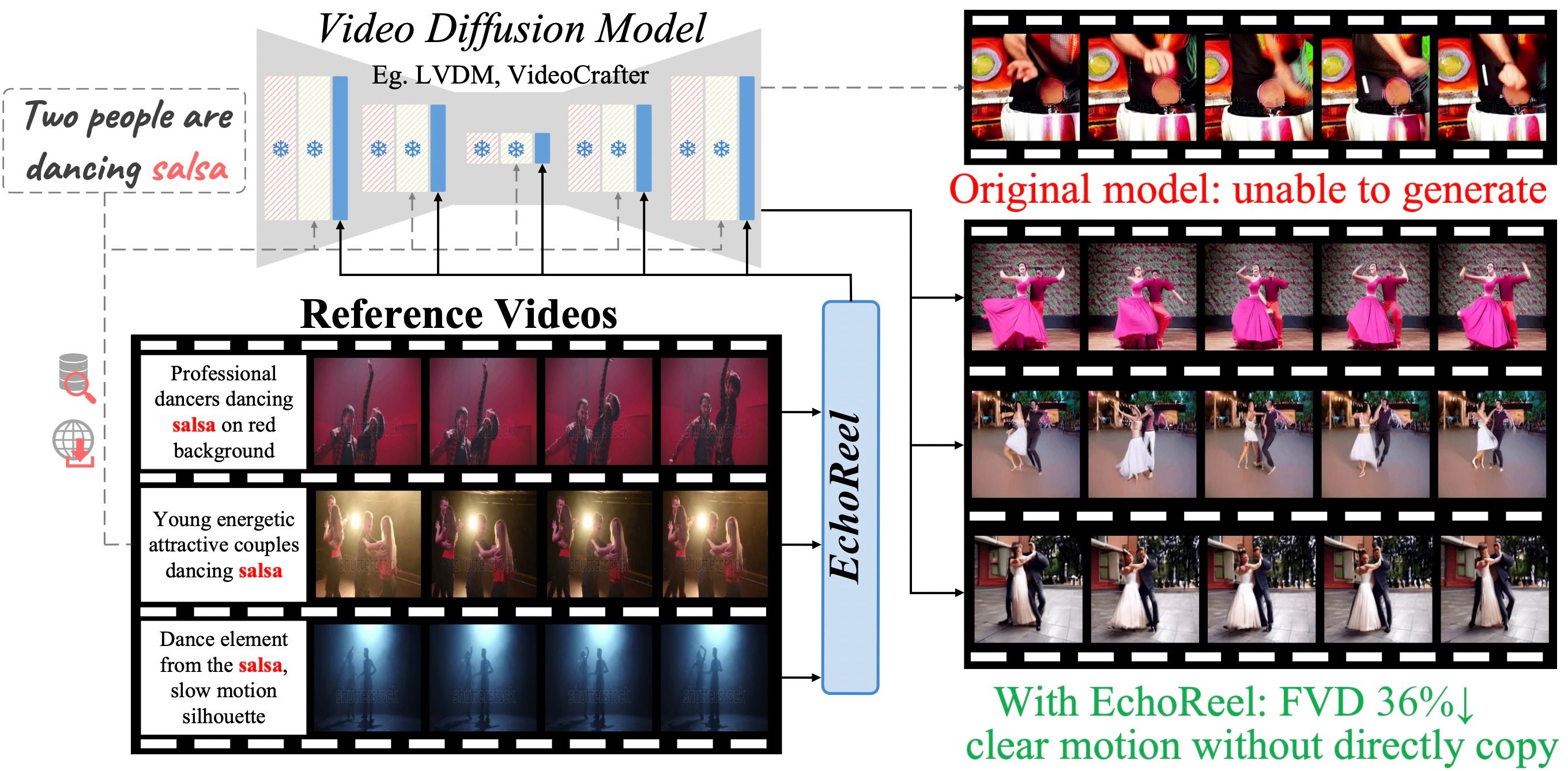
In a bid to boost the prowess of Video Diffusion Models (VDMs) in crafting complex actions, EchoReel offers a pioneering method aimed at integrating reference videos. Addressing the longstanding challenge of VDMs in fully grasping intricate motions due to their inherent limitations in comprehending extensive datasets, EchoReel seeks to bridge this gap by mimicking motions from existing videos, readily accessible from various databases or online repositories.
EchoReel acts as an augmentation tool for VDMs, bolstering their ability to churn out lifelike actions without undermining their core functionalities. The Action Prism (AP) component is geared towards distilling motion intelligence from reference videos. AP's training regimen requires only a modest dataset, ensuring efficiency without compromising effectiveness.
The method operates seamlessly within existing VDM frameworks, leveraging the intricate web of knowledge imbibed by pre-trained models. Through additional layers integrated into VDMs, EchoReel infuses new action features, obviating the need for laborious fine-tuning of untrained actions.
EchoReel's architecture comprises several key components, including Self-Attention (SA), Cross-Attention (CA), and Action Integration. SA and CA operate independently, processing queries, keys, and values to facilitate self-attention and cross-attention, respectively. Meanwhile, Action Integration embeds new layers into pre-trained VDMs, empowering them to navigate temporal motion generation with finesse.
Finally, EchoReel's training regimen relies on a basic loss function, ensuring simplicity and ease of implementation. During inference, while there is a marginal uptick in computation time, the benefits in motion feature extraction far outweigh this minor inconvenience.
Comments
None